
Doctor Sarah Gillian Jacobs
 Tall, attractive brunette. Almost always wears skirt, blouse and heels under a white lab coat. Natalia’s personal physician. She’s not telling her age, but she’s probably well into her 50s, if not older, but gene therapy and plastic surgery means she looks much younger. Not exactly youthful, just not… old looking. A highly skilled and much sought after gene therapist and plastic surgeon. Canopian born and bred, but has studied and worked in several places, including Terra (where she has connections ot the Holt Clinic) and New Avalon.
Dr. Jacobs is part of Natalia's inner circle, and hasn't always been very forthcoming. After the business with Ilsa/Natalia and the child, plus the trip to Terra, she and Takari has established a working relationship. There is no love lost between them, but she's no longer trying to make his life difficult. Maybe she'll thaw up a bit more now that Takari is in the know.
 01/30/19 01:05:00 pm,
 THE OLD WOLVES

The “Old Wolves”, sometimes called “The Wolf’s Own” (same as the name for the 1st Regiment) or the “Wolfpack”, or more rarely “Natalia’s Get”, consists of some key officers, such as the Wolf and Satan, but also apparently unconnected leaders like Stellar and Jinx, plus officers and noncoms in the lower echelons, including techs, infantrymen, and aerospace pilots. People like Baroness Natalia and Doctor Jacobs are also part of the mystery team. It’s not something that’s spoken of very much, but it’s pretty obvious that they share some kind of bond the others don’t. Membership is by invitation only. Age, rank and merit are definitely factors, but there are some young ones in the group, and some that are neither merited or highly ranked.

BATTLE ARMOR & JUMP TROOPERS

The Star League developed and deployed battle armored infantry. They were used as marines aboard ships and space installations, as shock troops to clear out conventional infantry, and to some extent as an anti-mech weapon. Full SLDF Battle armor is now lostech, but all major combatants employ jump infantry. Jump infantry wear armored exoskeletons (basically the IS version of battle armor), which allows them to carry more firepower into battle than normal infantry. Jump troopers get their name from the personal jump packs the use to improve their mobility. They are invariably elite soldiers, as the equipment requires a lot of skill to use and is too expensive for general use.
QUAD MECHS
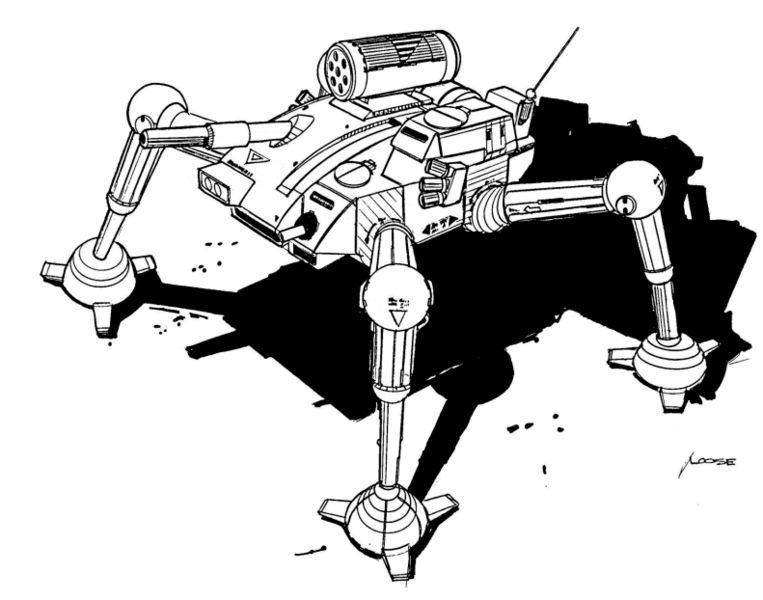
Quad mechs are a rare sight, but they do still exist (some analyst claim 1 in 50 mechs are quads, others say as few as 1 in a 100 or even less). Never popular or prolific to begin with, there are only a handful of minor quad mech production lines still in existence.
Quads do not share their bipedal cousins’ humanoid appearance, looking more like conventional tanks walking on four legs. Capabilities are somewhere between that of a mech and a tank. They retain the mech’s superior cross-country mobility, are more stable than two-legged mechs (but harder to right if they do fall), but not quite as agile. They are usually heavily armored, but tend to carry slightly less weaponry than bipeds of the same tonnage.
There is a great deal of bias against quad pilots amongst the general mechwarrior population. Most consider them little more than tankers. Even on Solaris they aren’t exactly popular: The annual Quad Games draw comparatively fewer spectators are prize money is a joke.
LAND-AIR MECHS (LAM)
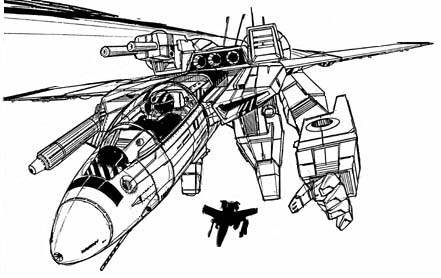
Originally conceived during the Star League era, the Land-Air Mech (or LAM) was a hybrid unit capable of transforming between BattleMech and Aerospace Fighter forms. The idea was to create a platform that could perform equally well in both roles, erasing the line between aerospace and ground combat.
It didn’t work out quite that well. After decades of work and countless SL-bills spent, working LAMs were produced and delivered to units. After even more years and more money, they were even declared operational, but in a more limited role.
Their high unit cost, extreme maintenance requirements, coupled with their relative fragility and light loadout relegated them to the recon role. LAM operations were further complicated by the operator needing to be a fully qualified mechwarrior and aerospace jock. Most people had more than enough with mastering one of those skillsets.
After the end of the Star League no new LAMs were produced, and what vehicles remained were either destroyed during the First Succession War or grounded for lack of parts or crew. A handful exist today, either as museum exhibitions or as stripped shells mounted outside major military bases or government buildings.
Only three LAMs made it past the prototype stage: The Stinger LAM (30t), the Wasp LAM (30t), and the Phoenix Hawk LAM (50t). Other LAM projects either produced no more than a few prototypes, or failed altogether. The most infamous project was the Shadow Hawk LAM, which ran from 2680 to 2750 without ever producing a machine that the SLDF would accept.
State of the mech tech
The Exodus and the 1st and 2nd Succession wars completely ruined the Inner Sphere’s tech base. Mechs are now built the equivalent of 2nd Gen tech – this is the so-called “IS tech level”. It is the technological equivalent of pre-to-early Star League.
Don’t make the mistake of thinking it isn’t advanced: It includes the ability to build gigantic walking tanks powered by fusion engines, armed with potent weapons and protected by nearly impervious armor, each more than a match for a platoon of tanks. Some tech fields lag a little behind, such as electronics, but they still advanced enough to guide said mech – and jump starships safely between the stars.
There is some variety within this tech level as well. The ability to build light mech frames and fusion engines still exist, for example. Not quite Endo-Steel/XL engine level, but still pretty advanced. Other examples include weapons with slightly better (or just different) stats from the baseline models. Many of the most advanced 2nd gen techs can only be created using highly automated factories from a long lost era. This kind of tech isn’t lostech per se, but it’s rare, expensive and not suitable for general use.
Lostech starts where 2nd Gen ends and 3rd begins. This is the mech technology from the mid-to-late Star League. Some of it is still in circulation though, testament to the skill of those who designed it and the durability of its construction. Much of it is classified as relics of a bygone era. The prices of such things are easily 10 times or more that of comparable 2nd Gen tech. If they can be had at all. Classic examples include ER energy weapons, pulse lasers, Artemis guidance systems, Ultra autocannons, double heat sinks, and super-complex computer systems.
Then there are the 4th Gen stuff, which was cutting edge even before the end of the Star League. The best examples of users are the “Royal” mechs, which were built using the best of 3rd Gen with a sprinkling of 4th Gen. The line is kind of blurred, and it can be hard to tell the generations apart (in GBT terms they are tagged with “experimental”).
Below all of this this is 1st Gen tech, sometimes called Periphery level tech, which is theoretically sufficient to build mechs, but only mechs with more primitive components. Could be full weight fusion engines that take up as much space as an XL engine. Or primitive armor that provide less health per ton.
Note that mechs don’t have to have a uniform tech level. A mech could be built in the IS using common 2nd Gen tech, but after years in the Periphery it has only 1st Gen armor – but a lostech pulse laser of the 3rd. A SLDF “Royal” mech would likewise be made entirely from lostech of the 3rd Gen, but could also have some systems not generally available to the rest of the Star League.
Some lostech still exist. Some mechs may contain original components, or at least some of them. Other mechs have access just to a single weapon or other lostech system that’s been fitted later.
Lostech is either preserved, scavenged or it is produced (in very limited numbers):
Preserved lostech are those bits that have lived on since before the lostech era (most people think ‘Star League’, but the fact is that it wasn’t until well into the 2nd SW that the true Dark Age began, so parts aren’t usually that old). If preserved tech has been used all the while, chances are it’s been repaired and rebuilt time and time again – even lostech doesn’t last forever without wear and tear.
Scavenged lostech is stuff from the lost era that’s been recovered. Maybe from a battlefield, maybe from an old storage facility, or from a mech that’s finally given in. Unlike preserved lostech it hasn’t been in continuous use, so it closer to the original. It will likely still need an overhaul before it can be used – stuff that lay around naturally decays. The holy grail of scavenging is finding a lost SLDF cache with mothballed mechs, but truth be told less lostech is scavenged for each passing year.
Produced lostech is made at one of the very rare robotic factories still in operation. Given the cost and complexity of these processes, most factories that could theoretically build lostech have been turned over to producing common mech parts.
Regardless of origin, lostech is expensive, if it can be had at all. If available, it typically costs 10 times or more that of a non-lostech part. Maintenance complexity (difficulty and time) go up, as do maintenance costs. For these reasons fielding a lostech battlemech force isn’t just a stupid expensive investment, it’s also going to be a constant drain on resources. If you get a 20-30% increase in efficiency, but a 100% increase in operating costs, why not simply have more standard mechs?
History of mech technology
The Mackie was the first operational battlemech, fielded by the Terran Hegemony in the 25th Century. This lumbering 100 ton monster ruled the battlefield when it arrived, but truth be told it had many systems that today would be considered primitive (it had protection and firepower, but none of the speed and agility we’re used to).
The Mackie was followed by the 1st Generation of battlemechs. Some, like the Combine Gladiator were failures, while others, like the humble Wasp (the first to introduce jump jets) or the Commando (the first mass-produced light mech) are still in production (albeit later variants), as are iconic mechs like the Shadow Hawk.
A period of intense development followed, where the Hegemony tried to retain its technological edge, and the other star nations sought to keep pace or even outdo the Hegemony. This 2nd Generation of battlemechs included a number of entirely new models, such as the Archer (recognized as the first mech built from the ground up using only 2nd Gen tech) but also a great deal of refinement of existing 1st Gen mechs.
Battlemech development continued unabated up until the creation of the Star League in 2570, but battlemech tech was already mature with 2nd Gen, and no major differences exist between late pre-League mechs and early post-League mechs. It was these 2nd Gen war machines that partook in the long and bloody Reunification Wars.
War is ever the catalyst for change, and battlemech technology continued to improve, giving rise to the 3rd Generation Battlemechs from around 2600. An example of a 3rd Gen mech is the iconic Marauder. This is the point where the first technologies that are now said to be lostech were introduced. For example, the first Marauder series had advanced CASE protecting its ammo stores and was among the first mechs to use Ferro-Fibrous armor. Mechs of the 3rd Gen would also have increasingly advanced computer systems, systems that are now either too expensive to field or completely extinct.
After the Reunifications Wars all the Inner Sphere had access to the same ever-expanding knowledge and tech base, paving the way for further advances in battle technology. By the mid-27th Century, however, only the SLDF was a relevant fighting force, far outstripping the House armies in size – and research budgets. Thus it was that only the elite units of the SLFD, the so-called “Royal” units got access to the penultimate 4th Generation battlemech technology.
During the reign of Jonathan Cameron (r. 2690-2738) a ban was placed on “Royal” tech to ensure that the Houses would not be able to gain access to this tech. The embargo was not entirely successful, but it did much to limit the spread of the most advanced technologies.
HPG operations
Most civilized worlds (meaning those in the Inner Sphere and major Periphery nations) will have some form of HPG service. HPG services are always provided by ComStar, and take the form of a ComStar compound (major worlds can have multiple compounds) built around one or more HPG generators.
The most visible part of a HPG generator is the transceiver array, which looks pretty much like a huge radio dish (or multiple dishes for larger compounds). There is more to it than that of course, but everything else is hidden below ground or behind thick concrete – and a wall of silence from the ComStar personnel that operate it.
HPGs do not operate continuously. They require enormous amounts of power, and are often run at night to minimize the load on the local power grid. Major compounds may have their own power generators (big fusion plants), and sometimes even sell energy to surrounding areas when there is a surplus (don’t forget that ComStar, for all their “monastic” posturing, is a business).
HPGs have about 50 ly range (by comparison a jumpship has 30 ly range), which is why there has to be a chain of them to reach far away worlds. To send or receive, the dish must be very precisely pointed towards the target world, which requires a great deal of calculation and fine tuning. To make it simpler, HPG relays mostly operate according to a very specific predetermined schedule. This schedule is decided and overseen by the main office on Terra.
Assuming you have access to an A-class facility, ComStar guarantees that your messages will reach any A-class facility within 24 hours (usually less). If there is a B-class facility, the estimate is 1-3 days to reach an A-class world, longer to reach B or C class. C-class facilities provide 1-7 days to an A-class, longer to reach B or C class. Those are the times ComStar guarantees. If alignments schedules match, it can go a lot faster.
There is also a system for priority messages for those in a hurry. There is no use just pointing the dish at any given world as the target needs to be actively listening in the right direction. Instead every HPG station will know the alignment of every other HPG station, and therefore where it can transmit/receive at any given moment. Based on the final destination a “path” is then calculated, the dish is moved to the correct alignment, and the message sent. Sometimes a priority message will have to be bounced back and forth quite a bit before it reaches its destination. Depending on the number of relay points, and the number of dishes that have to be realigned out of schedule, the base price can range from very high to astronomical.
Messages can be transmitted as text (common), images (also common), sound and live capture (costlier, but common enough), and data files (price varies with size). Live communication between adjacent systems is possible is the relays are at least B-class. Typically, this is sound only, or very low res images. It is very expensive.
It is technically possible to set up a real-time conversation across vast distances if arrays can be lined up all the way from one speaker to the next (you could even make a conference call between multiple star systems). This requires scheduling beforehand to align the various arrays. Every system involved has to be an A-class, except the terminus systems, which need only be B-class). Needless to say the cost of such a venture puts it beyond that reach of even wealthy people.
In a few places orbital arrays and deep space relays do exist, but they are very, very rare. They have no major benefits over planet bound relays, except they are less constrained by planetary interference. This is outweighed by the complexity and cost of building and maintaining such deep space relays. It also seems that ComStar just has a preference for building on planets. Maybe it’s a policy thing.
During the heyday of the Star League, some fleet flagships were fitted with HPGs, but it was seen as problematic because the mass of the HPG and its power requirements reduced the military value of the warship. There were also built a few fleet communication ships, but these were both vulnerable to attack and weakly armed. All of this is now lostech.
The Minnesota Tribe incident


In 2825, a strange but highly skilled unit using SLDF tactics, painted in non-regulation colors and bearing insignia reminiscent of the SLDF's 331st Royal BattleMech Division, a unit that had joined Aleksandr Kerensky's Operation Exodus, attacked four Draconis Combine worlds, stole resources, and left.
The first target was the minor world of Svelvik. The invaders refused to communicate with the Draconis Combine militia, defeated them in battle, took what they wanted, and left the system. They next attacked Trondheim, where the 20th Rasalhague Regulars were stationed. They defeated the numerically superior garrison, again refusing communication.
Coordinator Jinjiro Kurita, upon learning of this new enemy, shifted forces to the Periphery borders of both the Pesht and Rasalhague Military Districts.
At Jarett the DCMS Navy engaged the invaders as they made planetfall, but the appearance of a large number of enemy aerospace fighters won the attackers control of space. They used their aerospace supremacy to continuously attack DCMS mech forces, allowing the invaders to plunder yet another planet.
At Richmond the 331st liberated a camp of political prisoners in addition to seizing the usual goods. All of the camp personnel were shot on the spot and every inmate marched aboard their dropships, never to be seen again. Their motives for doing this were never fully understood.
The stampede of the "Minnesota Tribe" so worried the Coordinator that he ordered a halt in the preparations for the 2nd Succession War. Instead the entire DCMS Navy was tasked with hunting down and destroying the invaders. The final encounter took place over St. John, where warships of the DCMS-N cornered and destroyed the invaders' cruiser "Talleyrand".
No enemy prisoners were taken alive during the campaign: The closest the DCMS came to was an encounter with a lone, almost pristine Lancelot on Trondheim. After a lengthy struggle the DCMS brought down the enemy, but the mechwarrior did not eject. Instead he remained in the cockpit of his fallen mech, where he committed suicide with his service pistol before he could be subdued.
Upon examination the warrior was found to be clad in an advanced version of the SLDF's full body coolant suit. The suit had two patches: One with the numbers "331" stitched on it, which appeared to be a revised version of the insignia of the 331st Royal BattleMech Division "Minnesota". The other of a white Wolverine-like creature with bloodied fangs, which did not match anything on record.
Various theories were put forward as to the origins of the "Minnesota Tribe", but the official version was that these were just another group of pirates with access to a SLDF cache - or possibly the descendants of a splinter group which has left the Exodus.
Interstellar communications

ComStar has a monopoly on instantaneous interstellar communication, but NOT on interstellar communication in general. The HPG network is too limited for that. It requires an immense amount of energy to transmit signals between the stars, and the bit-rate of transfer is really too low for anything but text messages to be affordable.
A short text message sent to a nearby star could be as little as 1 C-bill, but a long text sent from one end of the Inner Sphere to the other could be as much as a Red Blake (100 denomination C-bills have a reddish color and have Blake on one side, hence the name).
GM Note: Doesn’t sound that expensive, until you realize 1 C-bill is about 10 dollars in current money. Who wants to spend 10 bucks or more just to e-mail their sister? Or a 1000 dollars to download Shakespeare’s works?
If you can afford it, you can get the bandwidth you need to send images, or even live footage. Depending on the number of nodes involved, transmitting a simple image could cost between 10 to a 100 C-bills. If it’s a hi-res image the price could be as high as ten times that (getting a good compression tool is recommended).
A lot of government and private communication instead takes the form of messages (text, images and whatnot) sent by courier ship. These are not necessarily dedicated courier ships – any old commercial dropship will do. Ship owners make a little money by acting as couriers. For the most part these mailmen are as inviolable (at least publicly) as ComStar – if you start screwing over basic postal services, civilization threatens to break down. You have to pay for these services too, but the cost is just a fraction of what ComStar charges. Sending some hi-res vids of you baby drooling to your sister isn’t going to cost you more than a stamp would, if that.
The way it works is that any dropship leaving a planet will query if there is an outgoing data dump for his destination – or anything further “downstream”. If it is, it will download it and the ship’s owner gets paid for the service. Upon reaching the jump point the ship will query other dropships and jumpships present, and transfer a copy of relevant messages going places they are headed (and pick up any messages they might have going forward). The process is repeated with every jump, until finally the dropship reaches its destination. If it went several jump, chances are great it picked up some more messages along the way. This way messages propagates out through space at a fairly good rate, but can still take weeks or even months to reach distant places.
Alternatively, priority messages can be radioed directly to a jumpship at one of the system’s jump point. This cuts the transfer time from planetary surface to the jump vessel, but dumping a great deal of data between a planet and a spaceship many light minutes away increases costs and greatly limits the bit-rate (some core worlds even have repeater sats orbiting the sun to boost such signals, but it’s rare). It’s cheaper than ComStar, and faster than by dropship, so it’s worth considering.