
A SPHERE IS A SPHERE IS A SPHERE
Despite the map being flat, the Inner Sphere is a 3D sphere, with an average radius of about 500 light years from Terra. This volume of space contains more than TWO MILLION stars. About 2000 of those stars have a major human presence, which means that about 1 in 1000 star systems are settled.
Generally speaking, the further you get from Terra, the more sparsely populated space is. So within 100-150 ly of Terra you might almost always find more than one settled planet within jump range, that’s far from the case near the nebulous edge of the Periphery.
Speaking of the Periphery: if you make the sphere bigger by including the near Periphery, there are suddenly about 5 million stars, but perhaps only 2500 settled worlds. There would be even more, but the galactic disk is only about 1000 ly thick, so the sphere is no longer a true sphere, but more like a discus.
If you want to include all of the Deep Periphery, say any region ever tenuously explored by humans, out to about 1500 ly, that’s a cool 20 million star systems. Who knows, maybe the descendants of Kerensky are out there, somewhere. Or maybe they we simply swallowed up by the endless dark ocean between the stars?
And humans had only barely begun to venture into the galaxy by the time the Star League came crashing down. Billions more stars await…
GM note: So space is 3D. No surprise there. But the map is 2D. And it stays that way. Let’s just keep the 3D aspect vague. The map doesn’t necessarily show a star’s exact spatial location, but its position relative to nearby stars within jump range. That’s what is important for us.

 09/10/18 06:06:00 pm,
 JUMPSHIP OPERATIONS
In Classic BT jumpships typically use the zenith (top) or nadir (bottom) jump points of a star. The term jump “point” is a huge misnomer. A star’s jump “point” is an infinite number of points where the gravity of the star is below the threshold where the K-F drive can safely operate. Essentially all of space beyond a certain distance, based on the mass of the star.
For a G2V size star like the sun, the minimum safe distance is 1.5 billion km, or about 10 AU. That’s 10 times the distance from Sol to Terra, or the equivalent to the orbit of Saturn (by comparison Jupiter is 5 AU from Sol, Mars 1.5 AU). Any point beyond this limit is fair game for a jump. Smaller stars have smaller travel distances while bigger stars have longer travel distances (it’s mass, not actual size that matters).
Using the Sol system as an example, a jumpship could jump into the plane of the ecliptic, somewhere near Saturn’s orbit, then make its way to Terra. Assuming the navigator was clever enough to emerge as close to Terra’s current position as possible, this would save a little over 1 AU from the 10 AU and change trip from zenith/nadir. That’s not going to meaningfully cut down transit time; instead of 9.1 days you’re spending 8.5 days under drive, hardly much difference.
The zenith/nadir points are chosen because they are very, very safe. There is almost no material there that can harm jumpships. The vast majority of a star system’s mass is located on the plane of the ecliptic, or close to it. While some rogue bodies can have wildly different orbits, the zenith/nadir points are almost entirely free of pollutants, thanks in no small part to the solar wind. Why take the huge risk of jumping into the ecliptic, when the gains are so minimal, yet the danger so much greater? A single pebble impacting the jumpship at high speed could cripple it. Even fine grains of dust can cause irreparable damage to a jumpship’s solar sail.
Furthermore, many civilized systems maintain recharge stations at either or both jump points. Here jumpships can charge their K-F cores faster (for a price), take on supplies and reaction mass, and meet up with the dropships they are to carry. In case of emergency aid is close by. Anywhere else and aid will inevitable arrive too late.
Jumpships don’t generally orbit a star, like a planet, comet, or artificial satellite does. An object orbiting a star has angular momentum (basically the rotational equivalent of linear momentum, or speed in a straight line). Basically, an object going at exactly the right speed, depending on the masses and distance involved, will continue to go round and round, instead of falling into the gravity well – or go careening into deep space. Jumpships don’t orbit a star because they want to stay in one spot over the zenith/nadir, where everything is safe and cozy.
Jumpships therefore require station keeping drives to avoid falling into a sun while recharging their K-F drives. Classic BT makes a point about sails being positioned BETWEEN the star and the jumpship, and the exhaust of the station keeping drives being angled slightly away from to avoid destroying the sail. This is kind of funny, because a solar power collector big enough to meaningfully charge a K-F drive, would certainly be big enough to take advantage of a star’s radiation pressure to keep the jumpship in position. Even if we assume that IS solar technology is far more advanced than our current tech (reasonable assumption), only a fraction of the photons will be converted into electricity – the rest will exert pressure on the sail.
It might actually be a problem to prevent the solar sail from propelling the jumpship AWAY from the jump point and into deep space. The gravity of Sun at 10 AU is so weak it wouldn’t take much radiation pressure to keep the jumpship from falling into the gravity well. So in our BT universe, the solar sail keeps the jumpship in position, and the ship kind of dangles from the sail – the reverse of the original!
Jumpships still have station keeping drives, but these are there to supplement the solar sail, and act as backups in case of sail damage/destruction. They can also be used for slow interplanetary travel (so can the solar sail, albeit much more slowly), with most jumpships having no more than a 0.1-0.2G safe thrust. Jumpships using their drives will have to be periodically resupplied with reaction mass (from a tanker dropship).
A trick some jumpships use is to fall deeper into the star’s gravity well. The closer you are to the star; the more power the sail can collect; the faster the drive recharges. The ship has to then climb out of the grav well again to engage the jump drive, but that isn’t normally a problem: it can use the solar sail or the station keeping drive, or a combination of both. Most captain won’t do this, for the same reason they won’t use pirate points: there is a VERY SLIGHT risk involved. And jumpships captains are trained to be risk-averse in the extreme.
Jumpships will routinely use their onboard fusion reactors to supplement power collection from the sail. Gravity is pretty weak at 10 AU, but so is the power output of the Sun (on Saturn the Sun is about 100 times weaker than on Earth). There is NO RISK to the K-F core as long as they don’t charge it too quickly. How quick is too quick? That depends on the quality of the ship and the skill of the crew.
Typically, a jumpship will need 6-9 days to recharge, using the sail alone, while staying at the jump point. Using the fusion reactor and/or the “dipping” process to speed this process can shave off 1-3 days, depending on external factors, for a total recharge time of 3-9 days. The presence of a recharge station at a jump point can reduce recharge time as low as 3 days, but that’s about the limit of how fast the jump core can be recharged without risk of damage. On average, ships take 5-6 days to recharge. Accounting for all other factors, on average a jumpship will make 1 jump per 7-day week.
The number of jumpships in the Inner Sphere (and the Periphery for that matter) is said to be small, compared to the heyday of the Star League. That may well be true, but there are still enough for there to be meaningful interstellar commerce, sometimes in bulk goods. Corporation own dropships, and so does merc companies and wealthy individuals. Presumably they want to go places, and require jumpships to do so. Jumpships are limited to about a jump a week, that’s just 50 jumps a year, not counting downtime for maintenance.
There are about 2000 planets in the Inner Sphere, and more if you count the Periphery (there is even commerce out in the Deep periphery, between worlds the IS folk have never heard about). Not all of them get regular jumpship visits. On the other hand, the major worlds have a LOT of traffic. For this to work, there must be thousands upon thousands of jumpships in service at any one time.
Despite this seemingly big number, they are still TOO FEW, and dragooning civilian ships into military service is a sure (it’s been done, too many times to count, so there is ample evidence) way of crippling the economy, creating famine and unrest, and general bad times for everyone.
GM notes: jumpships have been given a slight buff in terms of the number of dropships they can carry. Using the ubiquitous Invader-class as an example, it’s listed with 3 collars. In our campaign it has six collars, as well as several auxiliary attachment points that can be used to dock smaller craft, like drop shuttles. It can also accommodate a number of transfer shuttles and aerospace fighters in its two internal hangars.

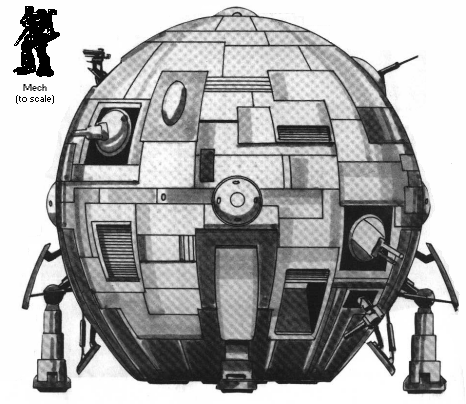
UNION-class Dropship
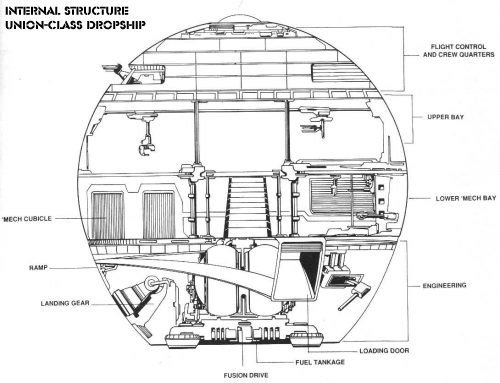
The iconic spheroid dropship. Over twice the empty weight of a Leopard, but much greater internal volume than mass suggest.
Has room for 12 mechs and 2 ASF, plus all supporting personnel, including a platoon of security troopers, some light vehicles and all the support personnel and logistics needed for the unit to operate in the field for some time.
Many claim the Union is cramped, and it surely is, but compared (again) to the Leopard it’s positively cavernous. While rooms are no bigger, there are more lounges and recreation areas, much better mess halls, and even a small sickbay and operations room (for the command staff).
Can only fly in the atmosphere under power of all four fusion thrusters is loaded. One thruster down allows emergency landing. If empty, it can manage to fly on 3 thrusters, but it’s very difficult to control.
There are two main versions of the Union: the military one, which can hold the listed amount of war machines and which is heavily armored and armed, and a support versione, which has no weapons or mech bays, but plenty of room for cargo.
Crew: 1 commander, 1 executive officer, 1 navigator, 1 weapon officer, 2 bridge officers, 3 system engineers, 2 drive engineers, 1 loadmaster, 1 steward, 1 crewman
LEOPARD-class Dropship
The Leopard is a very common military aerodyne dropship in use with every Great House, minor nation, and many corporations and mercenary companies. As dropships go it’s small, capable of carrying only a single lance (4) of mechs and a flight (2) of aerospace fighters. It’s 66 meters long, 51.6 meters wide, and 22.4 meters tall.
GM notes: a modern 747 is about 70 meters long, with a 60-meter wingspan, and a tail height of 20 meters. But the fuselage is only a slender metal cigar. If you imagine the Leopard as a massive flying brick taking up that entire space, from nose to tail, wingtip to wingtip, you’re not too far off. Basically it’s small, but HUGE.
The Leopard weighs 1900 tons empty, with a standard fuel load of 600 tons, with max takeoff weight in the 3200-ton range (depending on gravity, atmospheric density, and other factors). It can carry up to 4x100-ton mech, 2x100-ton aerospace fighters, and about 100 tons of cargo and consumables. The majority of the hull is taken up by the 4 mech and 2 aerospace bays, drive systems, and fuel tanks.
The mech/ASF bays are rigged to safely hold one mech/ASF of any class. It’s possible to stick more than one vehicle into a single bay, as long as they remain below 100 tons total. This isn’t recommended, however, as there is only one drop harness in each bay. Additional vehicles must be strapped in using chains and cargo straps, which isn’t ideal. The bays also become very cramped, making maintenance work nearly impossible. Exit/entry becomes time-consuming and a little difficult, so combat drops from overstacked bays is definitely not recommended.
Crew accommodations are located in the forward part of the ship, with the command deck situated front and topside. Additional crew areas are situated on the upper deck, behind the mechbay mezzanine. Accommodations are sparse since Leopards are designed for short operations and combat drops. Nevertheless, even “short” operations can involve weeks of travel in either direction, so the Leopard isn’t entirely without crew comforts. There is a mess hall, a small gym, a health station, and a longue.
The 9-man crew have their own quarters near the command deck, with the captain enjoying a private stateroom. The other 8 crew are housed in fairly spacious 2-man cabins. They also have their own mess and recreation area, away from the passenger compartments.
Leopards are designed to carry the personnel needed to keep a lance/flight operating in the field for a period of time. As such there are accommodations for double crews (8 mechwarriors + 4 ASF jocks) in 2-bed cabins. There is room for 24 techs in six 4-bed cabins. Most Leopards also feature an additional stateroom for important passengers, and 2-4 additional 2 or 4 bed cabins, but details vary from ship to ship.
Leopards typically carry sufficient supplies for about a month of operation. Anything beyond this eats from cargo tonnage. Leopards have VTOL capability, but prefer to land on hard-surface runways. They carry sufficient fuel to lift off and land (or vice versa) on a terrestrial world using VTOL, without refueling. It carries 74.5 1G burn/days of reaction mass, sufficient for a round trip to even the most hard-to-reach planet.
